
How it works
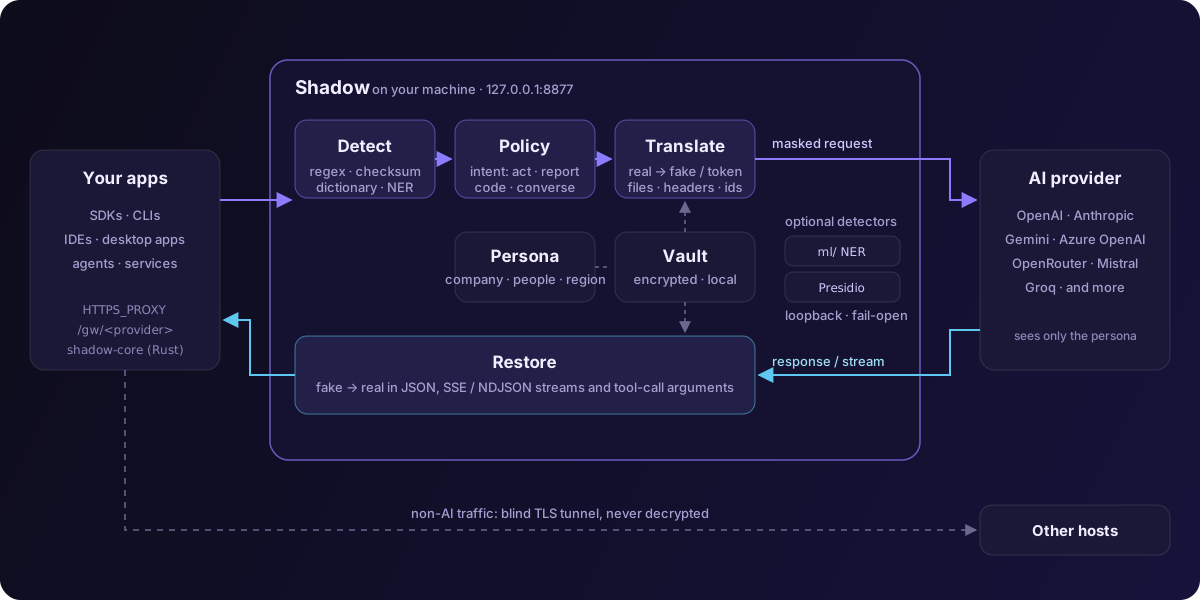
Shadow has three parts:
shadow-core(library): detection, persona, vault, intent policy and translation. Everything that touches real values.shadow-proxy(library): the HTTP(S) forward proxy, the/gwgateway, the local CA, file handling and the streaming translator.shadow-cli(theshadowbinary): setup, service installation, inspection tools.
Life of a request
Section titled “Life of a request”1. Intercept
Section titled “1. Intercept”Shadow listens on 127.0.0.1:8877.
- Gateway: the app sends
POST /gw/openai/v1/chat/completionsin plain HTTP on loopback. Shadow maps the route tohttps://api.openai.com/v1/chat/completions. - Proxy: the app sends
CONNECT api.openai.com:443. Because the host is on the intercept list, Shadow completes the TLS handshake itself with a leaf certificate minted by the local CA, then reads the HTTP request inside. For any host not on the list, Shadow opens a raw TCP tunnel instead and never sees the plaintext.
2. Prepare the body
Section titled “2. Prepare the body”Shadow decodes gzip or deflate request bodies, drops hop-by-hop headers and accept-encoding (so the response arrives uncompressed and can be translated), and looks at the content type:
- JSON is parsed and handled field by field.
multipart/form-datauploads, and base64 files embedded in JSON, go through file masking.- Requests signed with AWS SigV4 are forwarded unmodified with a warning, because changing the body would break the signature.
3. Classify intent
Section titled “3. Classify intent”With [policy] intent = true (the default), Shadow classifies the request as act, report, code or converse from the instruction, the tools offered and the shape of the data. The class decides the treatment of each detected value: a surrogate, a typed token, the real value, or a redaction. See Intent-aware policy.
4. Detect
Section titled “4. Detect”Every string leaf of the JSON body is scanned, apart from protocol keys (model, role, type, id, tool_call_id, and similar). Each string goes through every enabled detector:
- built-in regex and checksum detectors (emails, phones, cards, IBANs, national IDs, IPs, MACs, hostnames, secrets, paths, names, addresses);
- the dictionary of your organisation names and terms;
- local machine facts (OS user, hostname, git identity);
- optional: the local NER sidecar and Presidio.
Overlapping findings are resolved: the longest span wins, then the higher-priority kind (secrets first, then organisation terms, emails, financial IDs, names). Values on allow_terms, and values that are already fakes, are skipped.
5. Translate
Section titled “5. Translate”Each finding gets the treatment chosen by the policy. The default is a surrogate: a format-preserving fake from the persona, stored in the vault. The same real value always gets the same fake, and a fake is never reused for a different real value, so reversal is exact.
6. Scrub identifiers
Section titled “6. Scrub identifiers”- JSON fields
user,safety_identifier(OpenAI) andmetadata.user_id(Anthropic) are replaced with the persona’s user id. - Headers in
strip_headersare removed: by defaultOpenAI-Organization,X-Forwarded-For,X-Real-IP,Forwarded,Via,X-Client-IPand thex-stainless-*OS and runtime headers. - Headers in
persona_headersare rewritten when present, for exampleX-Request-Originbecomes the persona hostname.
7. Forward
Section titled “7. Forward”The masked request goes to the provider over TLS (rustls), directly or through upstream_proxy. Shadow logs one line per request with the method, URL and number of values masked. It never logs values.
8. Restore
Section titled “8. Restore”- JSON responses: every string leaf is unmasked, including tool-call arguments.
- Streams (
text/event-streamand NDJSON): see below. - Other content types pass through unchanged.
Streaming hold-back
Section titled “Streaming hold-back”LLM APIs stream text as many small JSON events. A fake such as Wei Zhang can arrive as "Wei" in one event and " Zhang" in the next, so byte-level replacement would miss it.
Shadow parses each event and routes the delta text fields of known formats (OpenAI Chat Completions and Responses, Anthropic Messages, Gemini, Cohere, Ollama-style NDJSON) through a per-channel StreamUnmasker. A channel is one content stream, such as one choice’s text or one tool call’s arguments. The unmasker holds back at most longest fake − 1 bytes, the minimum needed to recognise a fake that is still arriving, and emits everything before that immediately. When the channel ends, the held text is flushed into the closing event (or a synthesized copy of the channel’s last event).
The effect is that tokens keep streaming at the same pace, delayed by at most a few characters, and the concatenated output is exactly what unmasking the whole text would produce. Other string fields in events are unmasked directly.
What is not processed
Section titled “What is not processed”- Non-AI hosts in proxy mode: tunnelled, never decrypted.
- Images (passed through by default; no OCR), audio, WebSocket and Realtime APIs, and gRPC.
- SigV4-signed requests (AWS Bedrock with IAM signing). Bedrock with bearer API keys is masked normally.
See the security model for the full list of limitations.